


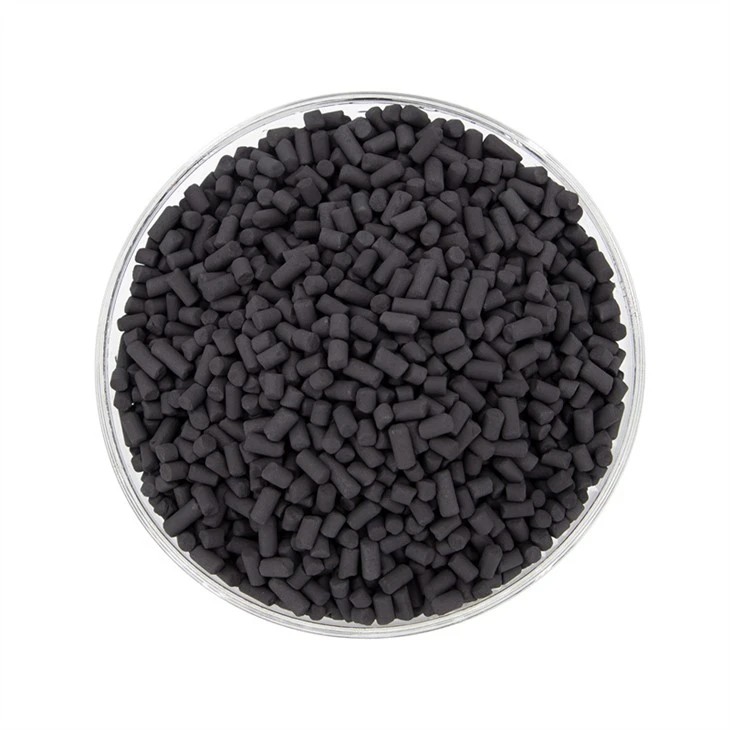
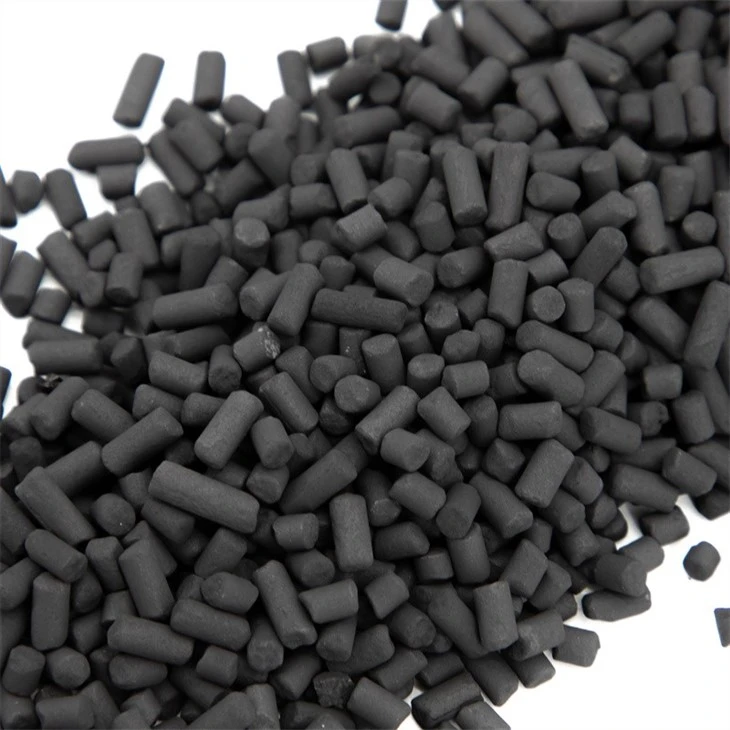
Coconut Shell Columnar Activated Carbon
Activated carbon is porous carbon material.Due to its highly developed porous structure and huge specific surface area, columnar activated carbon has very strong adsorption capacity, Its pores include micropores mesopores and macropores, diameter has >2nm,20-200nm, >200nm respectively. There are many oxygen containing functional groups on the surface of activated carbon, Activated carbon can also be impregnated with chemical substance to produce impregnated activated carbon.

It is obtained by carbonization of coconut shells under isolated air conditions at a high temperature of 600-900 ℃, followed by oxidation activation with air, carbon dioxide, water vapor, or a mixture of the three gases at 400-900 ℃.The cylinder shape is full and uniform, which greatly improves the wear resistance of the product. After entering the factory, there is no need for pre-grinding, and it can be used directly after washing with water.
| Type | Moisture content | Hardness | Apparent density g/L | Lodine number mg/g | Methyl blue mg/g | Ash content | Particle size /mm |
| Columnar 30 | ≤5% | ≥91% | 450-550 | 850-1100 | ≥120 |
10%-15%
|
3 |
| Columnar 25 |
≤5% |
≥91% | 450-550 | 850-1100 | ≥120 |
10%-15%
|
2.5 |
| Columnar 20 | ≤5% | ≥91% | 450-550 | 850-1100 | ≥120 | 10%-15% | 1.5 |
| Columnar 15 | ≤5% | ≥91% | 450-550 | 850-1100 | ≥120 | 10%-15% | 2 |


The production process of activated carbon

Activated carbon, is a specially treated carbon that heats organic raw materials coconut shell in the absence of air to reduce non-carbon components (this process is called carbonization), and then Reacting with the gas, the surface is corroded to produce a microporous structure (this process is called activation).
Because the activation process is a microscopic process, that is, the surface erosion of a large number of molecular carbides is point erosion, resulting in numerous small pores on the surface of activated carbon. The diameter of micropores on the surface of activated carbon is mostly between 2-50nm. Even a small amount of activated carbon has a huge surface area. The surface area per gram of activated carbon is 500-1500m2.
Columnar activated carbon is a kind of extruded activated carbon (EAC), It is made by extruding powdered activated carbon into long columns. An extrusion process is used to create extremely porous channels, providing greater surface area for better removal of contaminants.
These properties enable it to effectively remove contaminants such as heavy metals, volatile organic compounds (VOCs), and other water toxins impregnated carbon, etc. Columnar coconut shell activated carbon is used in gas purification, analytical chemistry, water purification, sewage treatment, and many other applications.
Columnar Activated Carbon Application Areas
1.Waste gas treatment.
Used for chemical raw gas, chemical synthesis gas, pharmaceutical industry gas, carbon dioxide gas and beverage hydrogen, nitrogen, chlorine, hydrogen chloride, ethane, cracking gas, inert gas purification. And cleaning the exhaust gas of atomic facilities. It is also used to remove pollutants from the air and to separate and purify mixed gases.
2.Industrial application
One major industrial application involves use of activated carbon in metal finishing for purification of electroplating solutions. For example, it is the main purification technique for removing organic impurities from bright nickel plating solutions. A variety of organic chemicals are added to plating solutions for improving their deposit qualities and for enhancing properties like brightness, smoothness, ductility, etc. Due to passage of direct current and electrolytic reactions of anodic oxidation and cathodic reduction, organic additives generate unwanted breakdown products in solution. Their excessive build up can adversely affect plating quality and physical properties of deposited metal. Activated carbon treatment removes such impurities and restores plating performance to the desired level.
3.Water treatment.
Urban drinking water, pure water, distilled water, ultra-pure water and other manufacturing equipment filling, dechlorination, oil reduction purification, all kinds of industrial sewage deep purification treatment.
4.Desulfurization and denitration treatment.
It is mainly used for H2S removal of biogas, water gas, semi-water gas, coke oven gas, natural gas, carbon dioxide gas, city gas, synthetic ammonia process gas, chemical raw material gas and other gases.
5.Formaldehyde treatment.
Newly renovated houses more or less have formaldehyde, which seriously affects our health. The use of activated carbon and ventilated areas for treatment is a good method.
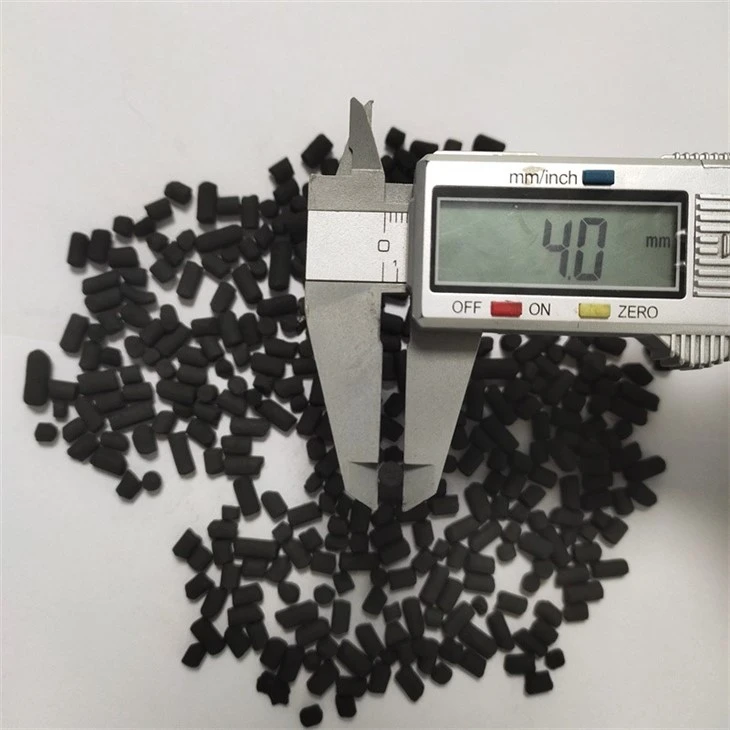
Columnar activated carbon common specifications: 1.5mm, 2.0mm, 3.0mm, 4.0mm, 5.0mm, 6.0mm, 8.0mm, 9.0mm. We are engaged in offering Coconut Shell Activated Carbon. This Coconut Shell Activated Carbon is highly demanded in the market for their excellent adsorption capacity. The application is very wide.


