


Honeycomb Activated Carbon
What is Honeycomb Activated Carbon
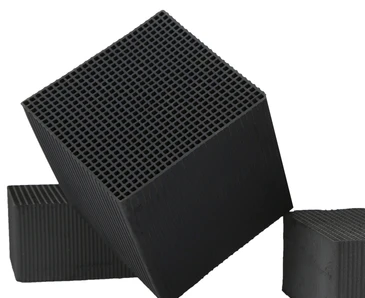
Honeycomb activated carbon is a new type of eco-friendly activated carbon waste gas purification product, which can effectively reduce odor and pollutants. The main raw materials of this product are high grade coal activated carbon powder, high iodine value coconut shell activated carbon powder, super decolorized wood activated carbon powder, pressed by mold, high temperature activation, and burned into a honeycomb shape activated carbon, so it is called honeycomb activated carbon.
Benefits of Honeycomb Activated Carbon
High specific surface area
Honeycomb activated carbon has a very high specific surface area, which means that there are more activated carbon atoms on its surface, which can adsorb more gas molecules or liquid molecules. This high specific surface area makes honeycomb activated carbon more efficient in the adsorption process and can remove harmful substances in the environment faster.
High adsorption performance
Honeycomb activated carbon has excellent adsorption performance and can effectively adsorb organic matter, heavy metal ions and impurities in various gases and liquids. In the fields of sewage treatment and waste gas treatment, the adsorption performance of honeycomb activated carbon can help quickly purify the environment and meet emission standards.
Good mechanical properties
Honeycomb activated carbon has good mechanical properties, is not easy to break or wear, and can be used for a long time. This mechanical property enables honeycomb activated carbon to maintain stable adsorption performance in various harsh working environments, improving its service life and reliability.
Easy to regenerate and reuse
Honeycomb activated carbon can be regenerated by thermal regeneration or chemical regeneration to restore its adsorption performance and reuse it. This regeneration reduces the cost of using honeycomb activated carbon, while also reducing the generation of waste, which is beneficial to environmental protection.


Why Choose Us
Competitive prices
We offer our products at competitive prices, making them affordable for our customers. We believe that high-quality products should not come at a premium, and we strive to make our products accessible to all.
Customer Service
We firmly believe that we offer THE BEST customer support in the industry and it is our ongoing goal to continually improve on our services. As an independently owned and operated business, we are able to provide the most accommodating service possible.
Professional team
We have a team of skilled and experienced professionals who are well-versed in the latest technology and industry standards. Our team is dedicated to ensuring that our customers get the best service and support possible.
Rich experience
Has a long-standing reputation in the industry, which makes it stand out from its competitors. With over many years of experience, they have developed the skills necessary to meet their clients' needs.
Efficient and convenient
The company has established marketing networks around the world to provide high-quality services to customers in an efficient and convenient manner.
Quality assurance
In terms of quality assurance, the company strictly follows the standards and norms of the industry quality system. Adopt industry-leading testing equipment to ensure product quality and good reputation.
Types of Activated Carbon Honeycomb
Honeycomb activated carbon can be classified into the following main types based on the final product' s shape:
Square-hole Honeycomb Activated Carbon
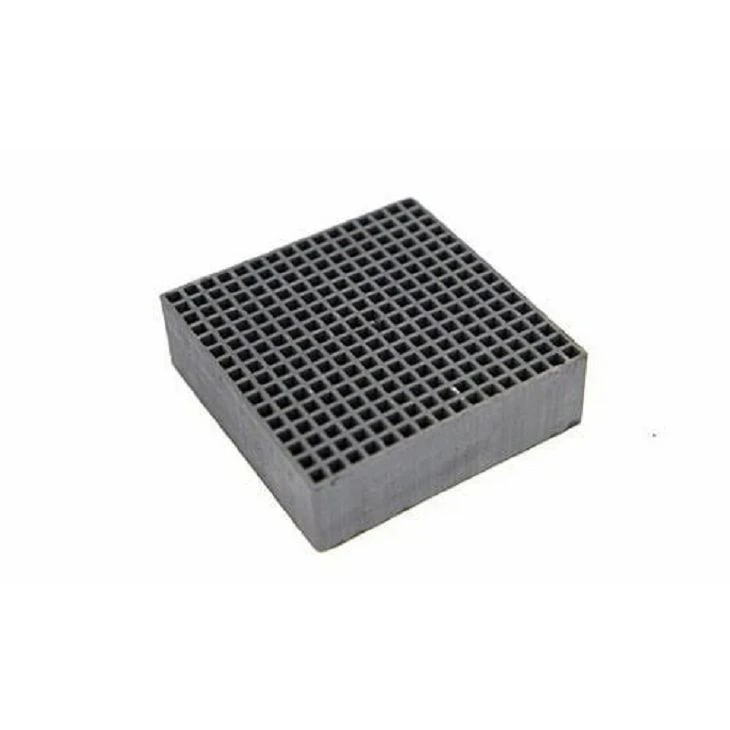
The honeycomb structure has regular square holes arranged neatly, suitable for applications that require uniform adsorption.
Round-hole Honeycomb Activated Carbon
The honeycomb structure consists of circular holes, making the overall structure more compact, and suitable for fields that demand relatively high pore structure.
Hexagonal Honeycomb Activated Carbon
Possesses a hexagonal honeycomb structure, providing stability while offering sufficient surface area, suitable for various adsorption and filtration applications.
Porous Honeycomb Activated Carbon
This type may contain holes of different shapes and sizes, providing diversified adsorption performance, suitable for handling complex pollutant combinations.
Honeycomb Activated Carbon VS Pellet Activated Carbon
Appearance
Honeycomb activated carbon is generally a porous cube with a large number of pores, which can be customized to different shapes and sizes according to customers' requirements; Pellet activated carbon is cylindrical with different specifications and lengths, which is not suitable for flexible customization.
Operation
Honeycomb activated carbon is simple and convenient to operate, it can be directly stacked and used, and it is easy to replace, if the gas concentration is large, a double-layer adsorption bed can be placed; Improper operation of pellet activated carbon can easily cause equipment blockage, and the replacement operation is very complicated.
Effect
Honeycomb activated carbon has well-developed pores and a large contact area, so the adsorption effect is naturally strong, and the pores help air circulation; Pellet activated carbon has a strong adsorption capacity, but for a high concentration of gases, the amount of input needs to be increased to ensure the effect, so it is easy to block the pipeline, and the operation difficulty increases accordingly.
Packaging and transportation
Honeycomb activated carbon is a fragile product, so it should be handled carefully in the transportation process, and now Huamei Company uses a new type of packing box with strong hardness and high protection performance, which greatly reduces the damage rate of the product; Pellet activated carbon can be placed in jumbo bags and packing bags, which is convenient for transportation.
Price
The price of honeycomb activated carbon is more competitive than pellet activated carbon with the same raw materials.
The global honeycomb activated carbon market size was USD 95 million in 2022. As per our research, the market is expected to reach USD 196 million in 2028, exhibiting a CAGR of 12.9% during the forecast period.
The activated carbon industry refers to the global market for honeycomb carbon products, which includes both the manufacturing and sale of honeycomb activated carbon. It is a type of activated carbon that is shaped like a honeycomb or hexagonal lattice structure. It is made by compressing activated carbon into a honeycomb shape, typically using a binder material to hold the particles together. Activated carbon is a highly porous material with a large surface area, which makes it effective at adsorbing impurities from gases and liquids.
The honeycomb structure of honeycomb carbon allows for a larger surface area compared to other activated carbon shapes, which enhances its adsorption capabilities. It is commonly used in industrial applications, such as air and water purification, due to its high adsorption capacity and efficiency. It is also used in automotive emissions control systems, as well as in the production of food and beverages, pharmaceuticals, and cosmetics.
Four Factors Affect Honeycomb Activated Carbon Performance
Harm: Dust adhering to the surface of the activated carbon will block the surface pore size of activated carbon, resulting in a reduction in the adsorption capacity of the activated carbon. In case of serious blockage, the activated carbon will completely lose its adsorption capacity, which will eventually lead to an increase in operation and maintenance costs and substandard exhaust emissions.
Suggestions: Well designing of pre-pretreatment equipment, select cloth bags and fiber cotton appropriately, and increase the effective interception area of the front end.
Harm: 1.When the relative humidity is higher than 75%, the adsorption efficiency of activated carbon for VOCs will drop linearly; 2.Activated carbon itself has no nutrients and does not have the conditions for mold reproduction, but the activated carbon in the humid box will be converted into mold nutrient base due to the adsorbed VOCs. Mold grows, and the higher the humidity, the crazier the mold grows, which further aggravates the decline in the adsorption efficiency of activated carbon, leading to the failure of activated carbon adsorption.
Suggestions: Please make sure to make the structural layout of the wading equipment, effectively remove the water vapor, keep the box dry, pay attention to regular inspection and maintenance of the equipment to prevent the activated carbon from becoming moldy (it is recommended to check the activated carbon inside the carbon box once a week).
Harm: 1.When the adsorption temperature of organic waste gas in the activated carbon box is higher than 45 ℃, the adsorption efficiency will be greatly reduced; 2.The ignition point of honeycomb activated carbon is higher than 400 ℃, so it will not burn if it hasn’t adsorb any VOCs and under the ignition point. If the activated carbon adsorbs a substance with low ignition point and the temperature in the activated carbon box reaches its ignition point, the substance will catch fire and ignite the activated carbon.
Suggestions: It is suggested that the temperature sensing probe should be reasonably arranged to ensure the actual use temperature of the multi-point detection box. The probe must be embedded in the middle of the carbon layer to effectively monitor the real temperature in the middle of the carbon layer, so as to avoid potential safety hazards caused by smoldering and fire caused by too high and unknown temperature in the middle of the carbon layer.
Suggestions: During the desorption process of special honeycomb activated carbon, the optimal temperature shall be controlled at 80-100 ℃, and the desorption time shall reach about 8 hours. The activated carbon box shall be well sealed, with safety measures and thermal insulation, and fire water spray shall be arranged inside the box. It is better for enterprises to install a nitrogen cooling system if possible. When the temperature of the carbon layer is too high, nitrogen will work to cool it. DO NOT immediately let fresh air in at high temperature, which will easy to cause smoldering.
Uses of Honeycomb Activated Carbon
Air purification
Honeycomb activated carbon is widely used in air purification systems, which can remove harmful gases and odors in the air, such as formaldehyde, benzene, sulfur dioxide, etc.
Water treatment
In the field of water treatment, honeycomb activated carbon can be used to remove organic matter, pigments, heavy metals and odors in water and improve water quality.
Industrial application
The honeycomb activated carbon adsorption method is adopted, that is, the exhaust gas is in contact with the porous activated carbon with a large surface, and the pollutants in the exhaust gas are adsorbed and decomposed, thereby playing a purification role. Pollutants that can be removed to varying degrees by honeycomb activated carbon include: nitrogen oxides, carbon tetrachloride, chlorine, benzene, dimethylaldehyde, acetone, ethanol, ether, methanol, acetic acid, ethyl ester, styrene, phosgene, malodorous gases, etc.
The modified honeycomb activated carbon impregnated with chemical reagents can remove: acid mist, alkali mist, amine, mercaptan, sulfur dichloride, hydrogen sulfide, ammonia, mercury, carbon monochloride, dioxin, etc.
Honeycomb activated carbon is widely used in various organic waste gas purification systems with low concentration and large air volume. The exhaust gas to be treated can fully contact with the activated carbon when passing through the square holes of the honeycomb activated carbon, the purification efficiency can reach more than 90%, the drag coefficient is small, and it has excellent adsorption, desorption performance and aerodynamic performance.
The waste gas treatment and purification efficiency of environmental protection equipment using honeycomb activated carbon is high, the volume of the adsorption bed is small, the energy consumption of the equipment is low, and the cost of construction and operation can be reduced. The purified gas fully meets the environmental protection emission requirements.
Food and Beverage
Used to remove bad taste and color from food and drink.
Honeycomb activated carbon is generally divided into two types, water-resistant and non-water-resistant, all index parameters are the same, and specifications and sizes can be produced according to customer requirements. activated charcoal cost The conventional size is 100*100*100mm, 50*50*100mm.
The best way to control air pollution is to use honeycomb activated carbon. Coal-based activated carbon consists of two adsorbers in parallel, which can be used to treat intermittent exhaust. Water purification activated carbon can be used for continuous exhaust. One of them is used for adsorption and the other is for adsorption. Desorption regeneration, catalytic combustion of desorbed pollutants and then exhausting.
Use honeycomb activated carbon to avoid high temperature as much as possible, because high temperature will reduce the adsorption capacity, and the adsorption effect will decrease due to temperature rise.
At the same time, avoid high dust content in the gas, because the tar dust mist will block the pores of the activated carbon, increase the wind resistance, and reduce the adsorption effect. In this case, a dust filter must be installed in front of the honeycomb activated carbon to improve efficiency and service life.
Manufacturing Process of Honeycomb Activated Carbon
Pulverized coal configuration
Lignite or bituminous coal and coking coal are crushed to ≤ 2mm respectively, then mixed according to the mass ratio of lignite or bituminous coal: coking coal = 1:0.2-0.5, and then ground to 74 μ M or less to obtain pulverized coal with uniform mixing.
Emulsified Coal Tar
In the first step, the asphalt content is ≥ 55%, and the high-temperature coal tar is preheated to 120-150 ℃; The second step is to prepare the emulsifier aqueous solution, add 2-6% surfactant of high-temperature coal tar mass and 0.5-2% stabilizer of high-temperature coal tar mass into the water, and preheat to 80-90 ℃ to form the emulsifier aqueous solution; In the third step, according to the mass ratio of high-temperature coal tar: emulsifier aqueous solution = 1 ∶ 0.3-0.7, under the condition of stirring, the high-temperature coal tar is added into the emulsifier aqueous solution to make Emulsified Coal tar.
Processing of plastic slime
According to the mass ratio of pulverized coal Emulsified Coal Tar: water: water-soluble adhesive: lubricant = 34-57 ∶ 30-36 ∶ 6-29 ∶ 3-5 ∶ 2-3, add it into the kneader and stir evenly to make plastic slime.
Sliming
The plastic slime is treated by vacuum sliming machine or extrusion molding machine to mix the slime evenly, and then filtered with 60 to 100 mesh screen in the molding machine to remove large particles.
Extrusion molding
The coal slime after mud refining treatment is added into the extrusion molding machine equipped with honeycomb steel mold for molding to obtain wet honeycomb.
Drying
Dry the wet honeycomb until the moisture is less than 2%.
Carbonization and activation
Use inert gas as shielding gas, heat it to 600-800 ℃ at the heating rate of 3-5 ℃ / min, and carbonize at this temperature for 2-3 hours; Then, according to the heating rate of 5 - 15 ℃ / min, it is heated to 750-850 ℃, activated with steam for 3-15 hours, and finally made into coal honeycomb activated carbon through multi-channel process.
Our Factory
Our factory covers an area of 10000㎡, of which the workshop takes up 5000㎡. It is located in the East Section of Chuangye Road, Beishankou Industrial Park, Gongyi City, Henan Province, China. It has the largest fiber ball and comet fiber filter production line. It has 300 employees, 6 senior engineers, 20 technical staff. It was equipped with a perfect production technology management system and quality guarantee system.

Certifications
Certificate: All the products passed CE, SGS, AMZ, ISO9001 certificates.
The raw material passed REACH test.
Our Patents include Modified Fiber Ball Filter, Comet Fiber Filter, and Modified Comet Fiber Filter (Degreasing Dedicated).

FAQ