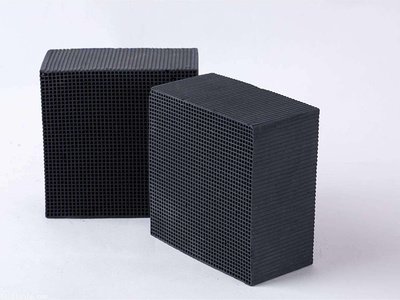
Honeycomb Activated Carbon
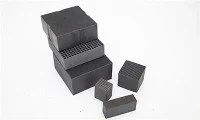
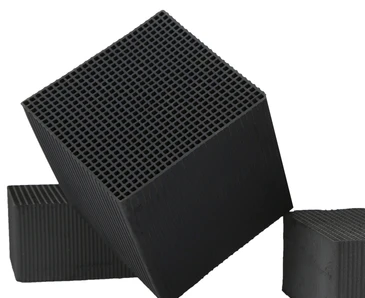
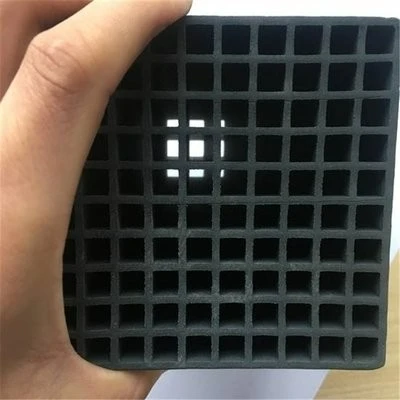
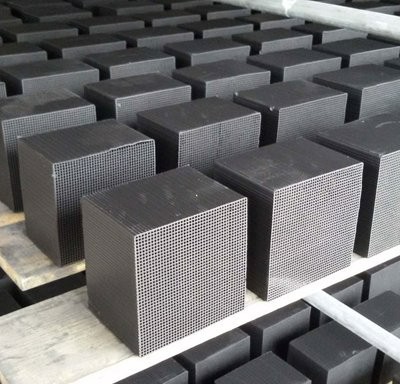
Honeycomb-like activated carbon is a new type of absorption material made by high quality powder activated carbon and binder. Honeycomb carbon block has a large amount of through holes from one end to another end in a cubic or cylindrical shaped block. Honeycomb carbon filter is a type of high effective carbon filter to remove unpleasant odors, particulates and other pollutants. Practice has proven that the purification effect is better than ordinary activated carbon.
This kind of structure gives low pressure drop, high mechanical strength and more contact surface with gas. Honeycomb carbon block is mainly used for vapor phase pollutants removal. Now it is widely use for air purification system which is high flow rate, low-concentration VOC pollutant air streams.
| Item No | Honeycomb Activated Carbon |
| Main Ingredients | Activated Carbon |
| Specification | 50*50*100mm 100*100*100mm 100*100*30mm |
| Pore Density | 50-300 pore/in2 |
| Bulk Density | 0.3-0.45g/ml |
| Desorption Temperature | < 120℃ |
| Wind Speed | 0.8m/s |
| Positive Compressive Strength | >1.2 MPa |
| Rate of adsorption to benzene vapor | > 36% |
Waste Gas Treatment Honeycomb Activated Carbon
Activated carbon is able to remove undesirable or harmful gaseous components from air streams. The molecules collect on the relatively large internal surfaces of the honeycomb.
The pollutants can be removed by honeycomb activated carbon: benzene, carbon tetrachloride, acetone, ethanol, aether, carbinol, acetic acid, ethyl ester, cinnamene, chlorine, phosgene, foul gas, butane, methanol, styrene, malodorous gases and other acids can be used to remove carbon monoxide, carbon monoxide, carbon tetra.

Honeycomb activated carbon has similar adsorption performance and a larger geometric surface area to ordinary activated carbon. Its biggest feature is that the airflow resistance along the opening direction is extremely small. At the same airflow velocity (>0.5m/s), its resistance is only about 1/10 of that of granular carbon (4-6 mesh) compared to the same period last year. At the same time, the emergence of water-resistant honeycomb activated carbon has increased the application range of honeycomb activated carbon, making it widely used in more waste gas treatment plants.
Advantages of Honeycomb Activated Carbon
The honeycomb structure has a pore size range of 10-2,000 Angstroms and a BET surface area range of ~200-3,000 sq.m/gm.
The honeycomb carbon block is desorbed with liquid ring vacuum pumps and a small quantity of heated condensation compound free air – the adsorbed compounds are stripped.
The shorter distances for internal diffusion mass transfer for honeycomb carbon leads to faster saturation and desorption rates and thus shorter cycle times.
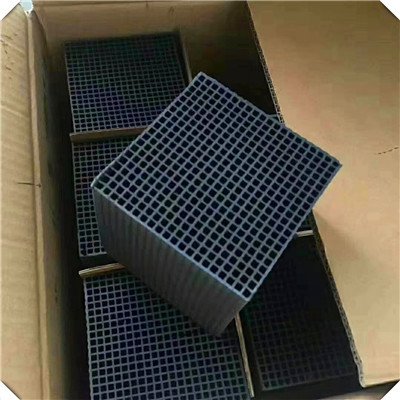
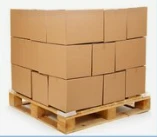
Packaging
Get in touch with us today
for more information on our activated carbon products or get quotes, samples, TDS and MSDS, etc.