


Modified fiber ball for purification of urban drinking water and oily industrial wastewater
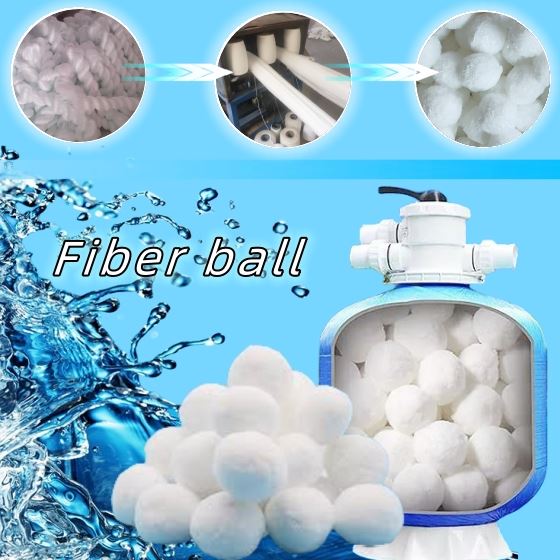
Fiber balls are made by tying fibers together. Compared with traditional granular filter materials, they have advantages such as good elasticity, non floating surface, large pores, small head loss, and resistance to acid and alkali; During the filtration process, the gaps in the filter layer gradually decrease along the direction of the water flow, which is in line with the ideal distribution of gaps in the filter material from top to bottom. It has high efficiency, fast filtration speed, strong pollutant interception ability, and is renewable, suitable for filtration of various water qualities.

The modified fiber ball filler adopts a new type of binding method and unique spatial structure, which has excellent oil removal effect. The fibers used in the modified fiber ball filler have good elasticity and a smaller diameter. The fiber ball filler made of it has the advantages of large specific surface area, high porosity, high strength, large pollutant carrying capacity, strong adsorption capacity, and good filtration effect, making it the preferred filtration product in the current oily wastewater treatment industry, It is also suitable for deep treatment and fine filtration of various water quality in enterprises.
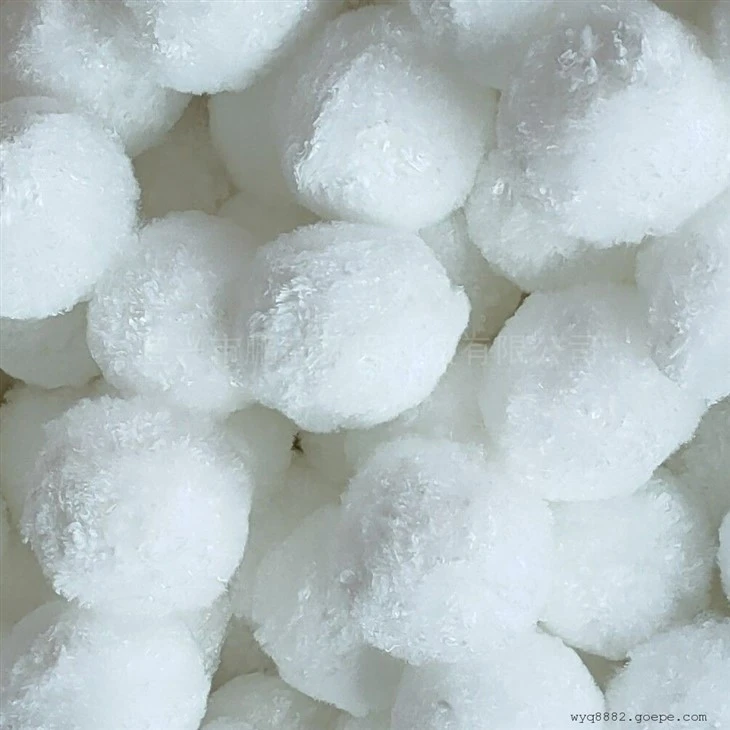
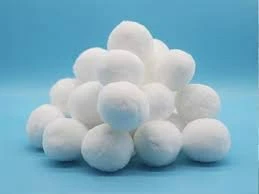
Modified fiber ball filler is a new type of material developed for oily wastewater treatment, which is based on fiber ball filler and is made of high-quality fiber filaments through chemical modification treatment and a series of exquisite craftsmanship. It has a white slightly yellowish appearance, a circular ball shape, excellent oil and water repellency, good adsorption effect on oil and suspended solids, strong backwashing and regeneration ability, even after long-term immersion in crude oil, It can also be cleaned in a short period of time using room temperature water.
Product technical indicators
| Intensity | 4-6 grams/dan | Acid resistance | 35%HCL |
| Moisture absorption rate (20 ℃ RH65%) | 0.4--0.5% | 75%H2SO4 | |
| Proportion | 1.39g/cm3 | 65%HNO3 | |
| Softening point | 238~240℃ | Alkali | 10%NaOH |
| Melting point | 255~260℃ | Wear resistance | Excellent |
| Sunlight resistance | Excellent | Microbial resistance | Not moldy or decaying |
| Common specifications | Ф50 | Appearance | White spherical, elliptical |
| Bulk density | 60~80kg/m | Porosity | 96% |
Working principle
The mechanism of removing oil and impurities with modified fiber ball fillers is that when the adsorbed oil droplets coalesce to a certain size, they automatically fall off under hydraulic flushing and are trapped in the gaps between the fillers. The oil in the inlet water has more time to contact the hydrophilic fillers, causing more oil to wet, adsorb, and coalesce on their surfaces, thereby improving the removal rate of oil. At the initial stage of filtration, the turbidity of the effluent is relatively high. As the filler layer gradually matures, the turbidity of the effluent gradually decreases, reaching a relatively stable stage. During operation, the pores of the filter layer are sparse above and dense below, and the porosity of the filter layer gradually decreases along the direction of water flow, forming an ideal distribution pattern of large and small pores on the filling material
Application in filters
(1) The modified fiber ball has a fine diameter and a large specific surface area, with a specific surface area of up to 2000 ㎡/g. Due to the fine diameter of the fibers, the superimposed filter layer has small pores, while the superimposed filter layer has a porosity of over 80%, and its interception effect on suspended solids is better than other filter materials. Therefore, the treatment of injected water in low permeability reservoirs is particularly ideal; Filtering with requirements for the discharge and reuse of highly suspended water is more suitable.
(2) The fiber filament has been modified to have hydrophilic and hydrophobic properties. Whether the modified fiber is coated with pure oil or oily wastewater, water molecules can penetrate the surface of the modified fiber when encountering water, forming a water film that separates the fiber from the oil; During backwashing, it can clean the crude oil adhering to its surface, and the backwashing regeneration performance is particularly good.
(3) Modified fiber balls have a larger specific gravity than ordinary fiber balls and are not sticky to oil. They can sink to the bottom of the tank under hydraulic pressure during filtration, and the pore structure of the upper and lower tight filter layers is good; When the modified fiber ball filter material is running, the porosity of the filter layer gradually decreases along the direction of the water flow, forming an ideal distribution of pores in the upper and lower parts of the filter material. The interception effect is enhanced, and the filtering effect is good.
Application Fields
The modified fiber ball filler has a slightly higher specific gravity than water and is easy to backwash. The material has strong wear resistance and chemical erosion resistance, and its physical and chemical properties are stable. State. Modified fiber ball fillers have a long filtration cycle, high oil removal rate, and an average oil removal rate of about 20% higher than ordinary fillers. They are widely used in high standard wastewater treatment in industries such as petrochemical, metallurgy, and power.

Modified fiber balls are suitable for fine filtration of oily wastewater in oil fields and also for fine filtration of other industrial wastewater. The mechanism of removing oil and organic matter by modified fiber balls is: direct interception, inertial interception, and electrochemical adsorption. Water quality before filtration: oil content ≤ 15mg/L, suspended solids ≤ 10mg/L; The filtered water contains ≤ 5mg/L of oil and ≤ 2mg/L of suspended solids.

The same modified fiber ball has hydrophilicity and oil repellency, good backwashing and regeneration performance, and is currently an ideal fine filtration material suitable for oily wastewater treatment. Widely applicable for drinking water treatment, industrial water treatment, circulating water treatment, cooling water treatment, sewage treatment, water treatment, etc.


