Low Price Water Purification 25kg Granules Tablets SDIC Dihydrate 56% Price Sodium Dichloroisocyanurate
SDIC is an efficient disinfectant with high solubility in water, long-lasting killing ability, and low toxicity. Therefore, it is widely used as a disinfectant for drinking water and household use. SDIC can hydrolyze into hypochlorous acid in water and can replace it in some situations, so it can be used as a bleaching agent. And because SDIC can be produced on a large scale, it is widely used in many industries


Product Features
(1) Strong sterilization and disinfection ability. The effective chlorine content of pure SDIC is 56%. It has a strong disinfection and sterilization effect, and the sterilization rate reaches 99% at 20ppm. It has a strong killing effect on various bacteria, algae, fungi, and pathogens.
(2) The product has a wide range of applications, not only for the food and beverage processing industry and drinking water disinfection, but also for the cleaning and disinfection of public places. It is also widely used in industrial circulating water treatment, household hygiene disinfection, and disinfection in the aquaculture industry.
(3) The effective chlorine utilization rate is high, and the solubility of SDIC in water is very high. At 25 ℃, 30g of SDIC can be dissolved in every 100mL of water. Even in aqueous solutions with water temperatures as low as 4 ° C, SDIC can quickly release all the available chlorine it contains, fully utilizing its disinfection and sterilization effects. Other solid chlorine containing products (excluding chlorinated isocyanurates) have significantly lower chlorine values than SDICs due to low solubility or slow release of chlorine.
(4) The stability is good, and due to the high stability of the triazine ring in the molecules of chloroisocyanurate products, the SDIC properties are very stable. According to measurements, after storing the dried SDIC in the warehouse, the loss of available chlorine is less than 1% after 1 year.
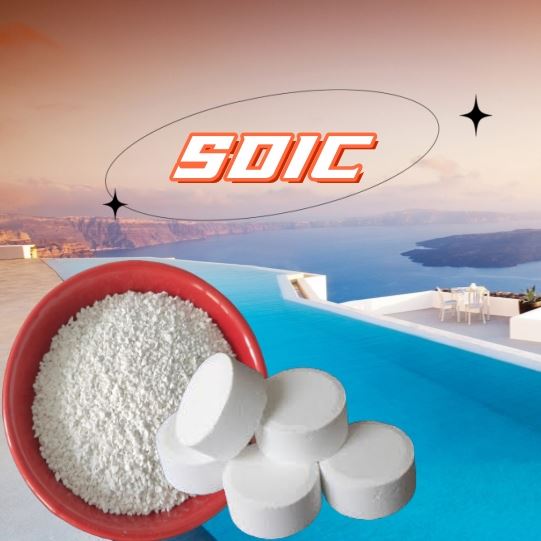
(5) The product is solid and can be made into white powder, granules or tablets, which is convenient for packaging and transportation, as well as for user selection and use.

| ITEM | STANDARD | |
| Available chlorine ≥ | 56% | 60% |
| Moisture ≤ | 7% | 3% |
| PH value(1%water solution) | 5.5 | 7 |
| Specification |
Powder;grain size(8-30mesh;20-60mesh);20g/tablet;2g/tablet;1g/tablet;5g/tablet;200g/ tablet Etc. |
|
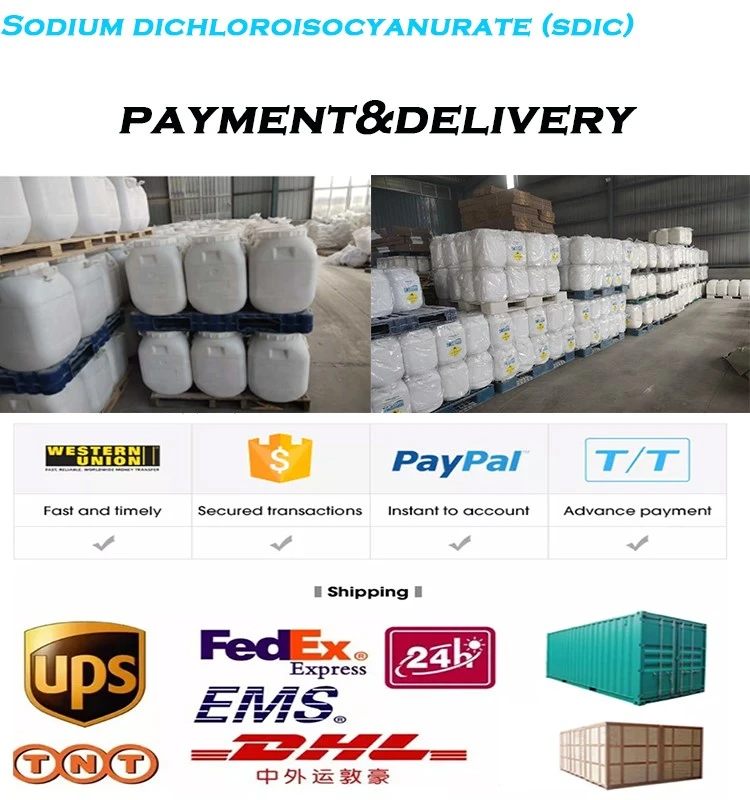
| Packaging | 25kg/woven bag;1000kg/woven bag;25kg/plastic drum;50kg/plastic drum;50kg/fibre drum | |
Application Areas
SDIC is an efficient disinfectant with high solubility in water and long-lasting killing ability, making it widely used as a disinfectant for drinking water and household use. SDIC can hydrolyze into hypochlorous acid in water and can replace it in some situations, so it can be used as a bleaching agent. And because SDIC can be produced on a large scale and at a lower price, it is widely used in many industries:


(1) Wool anti shrink treatment agent
SDIC can uniformly release hypochlorous acid in aqueous solution and interact with protein molecules in the wool scale layer, breaking some of the bonds in the protein molecules, causing changes in their molecular structure and preventing wool shrinkage. In addition, SDIC can also be added to detergents such as laundry detergent to effectively prevent wool adhesion, pilling, and other phenomena when washing wool products. The wool fabric treated with SDIC has bright colors, good hand feel, and almost no shrinkage; Adding 2% to 3% SDIC solution to wool or wool blended fibers and fabric soaking treatment additives can effectively prevent the occurrence of pilling, felting, and other phenomena in wool and its products.
(2) Textile industry bleaching
SDIC is also widely used as a bleaching agent for natural and synthetic fibers in the textile industry. The principle of bleaching is to cause the destruction of pigments in natural fibers and synthetic fibers. SDIC can uniformly release hypochloric acid in aqueous solution. Hypochloric acid can react with some chromophore groups in the fiber and undergo addition reactions with its conjugated bonds, damaging the original pigments in the fiber and changing the wavelength of the fiber's absorption of light, thus achieving the goal of bleaching.
Compared to using traditional bleaching agents, SDIC has significant advantages. Traditional bleaching agents can only be used at lower temperatures, as the speed at which traditional bleaching agents damage the molecular structure of fibers increases and the strength of fibers rapidly decreases under their influence. Even at lower temperatures, SDIC can still achieve good bleaching effects; In addition, the use of SDIC has a slower rate of damage to the molecular structure of natural and synthetic fibers, a good bleaching effect, and the strength of the fibers will not be greatly affected.
In addition, adding SDIC to bleach can also improve the hydrophilicity of clothing, remove cotton pulp from clothing, reduce the degradation rate of cellulose, and improve the flexibility and ductility of clothing.
(3) Sterilization and disinfection of the aquaculture industry
(1) If there is some negligence in the sterilization and disinfection of silkworm rearing, bacteria and pests can cause damage to the silkworm, and even cause the silkworm to die. Using SDIC as the main component, adding an appropriate amount of stabilizer and promoter to evenly mix the three to form a disinfectant aqueous solution, disinfecting and disinfecting the silkworm body and the living environment in which it is located, can quickly kill viruses, fungi, and bacteria that affect the silkworm.
SDIC aqueous solution can be sprayed on the silkworm chamber, tools, and body, which can prevent and control silkworm diseases while killing gastrointestinal pyogenic polyhedra, gastrointestinal pyogenic virus, and hematogenous pyogenic polyhedra. Compared with traditional silkworm disinfectants, disinfectants with SDIC as the main component have higher solubility, greater stability, and longer duration of efficacy. As an excellent disinfectant for the development of sericulture, SDIC has no impact on the growth, development, and quality of silkworms.
(2) The sterilization and disinfection of aquaculture have also shown impressive performance in preventing and treating fish diseases. It can quickly kill bacteria, fungi, and other microorganisms in water bodies, and can also prevent and treat viral diseases of fish. So SDIC is often used for water disinfection of aquaculture products such as fish, shrimp, crabs, and frogs. It also has certain applications in fish seed disinfection and fish gear disinfection.
Disinfection effect of sodium dichloroisocyanurate on drinking water: After disinfection of drinking water, the survival rate of chickens is about 97%, while the average survival rate of chickens without disinfection of drinking water is 90.07%, an increase of nearly 7 percentage points. Drinking water disinfected by sodium dichloroisocyanurate to chickens is greatly beneficial to their health, greatly improving their survival rate, and naturally improving economic benefits.

Civil hygiene disinfection
(1) Adding an appropriate amount of SDIC to household tableware detergent and other detergent additives can increase the function of the detergent, enabling it to play a role in disinfection and sterilization. The effect of cleaning stains containing protein and fruit juice is very significant. 600mg of SDIC can be weighed and added to 1L of water. Soaking and disinfecting the tableware in water for 2 minutes can kill 100% of Escherichia coli. After soaking and disinfecting for 8 minutes, the survival rate of Bacillus decreased to only 2%. After soaking and disinfecting for 15 minutes, the hepatitis B virus can be completely killed. In addition, SDIC is also widely used in the disinfection of agricultural products such as fruits and vegetables, poultry and eggs, and is a commonly used additive for refrigerator disinfectants and bathroom disinfectants and deodorants.
(2) Disinfection of swimming pool water bodies. The water in the swimming pool is very suitable for the reproduction of microorganisms such as bacteria. If not frequently disinfected, other microorganisms such as algae will quickly breed, causing the pool water to emit a nauseating odor and adhere to the pool wall to form a layer of slippery and dirty dirt. Touching these dirt while swimming can cause a sense of disgust among swimmers, as well as infect their skin and even their eyes, respiratory tract, and respiratory organs. You can add an appropriate amount of SDIC disinfectant tablets to the swimming pool water, which not only keeps the water clear and shiny, but also keeps the pool wall clean, removes adhesive substances, and makes swimmers happy both physically and mentally. Under the concentration of use, SDIC disinfectant tablets have good bactericidal effect and have little harm to the human body.
(3) Disinfection of drinking water. Adding an appropriate amount of SDIC to drinking water can quickly kill various bacteria, viruses, and other microorganisms. Not only that, SDIC can also destroy molecules of pollutants such as hydrogen sulfide in water, eliminating their color and odor. SDIC has a significant killing effect on inflammatory viruses and Escherichia coli. Adding 10mg of SDIC to every liter of water resulted in a survival rate of 0.01% for Escherichia coli in the water.
Industrial circulating water treatment
Many thermal power plants, petroleum refining plants, and chemical plants generate a large amount of heat during the production process. This heat requires a large amount of cooling water to be treated. Generally, these industries use heat exchange equipment such as heat exchangers, condensers, circulation pipelines, cooling towers, pump systems, etc. However, algae in these heat exchange devices are very easy to reproduce and breed a large amount of dirt. The use of fungicides can effectively treat algae in cooling water, among which SDIC is a commonly used cooling water fungicide. SDIC can effectively inhibit the proliferation of algae and microorganisms in cooling water, and has minimal erosion on industrial equipment, which can maintain good water quality in the circulating water system for a long time. Therefore, SDIC is an important component of industrial cooling water treatment agents.
Cleaning and disinfection of food industry and public places
Food processing industries such as dairy processing plants, breweries, and other beverage factories have also begun to use SDICs extensively for cleaning and disinfection. Mainly used for disinfection and sterilization of processing equipment such as containers, pipelines, tools, and fields. Some catering industries such as cold drinks shops, tea houses, restaurants, etc. often use SDIC to disinfect tableware such as trays, bowls, tablecloths, and towels. Using SDIC can maintain the hygiene of tableware and food processing equipment, eliminate stains, mold, odors, etc. caused by proteins, maintain the luster of tableware, and prevent the spread of diseases.