


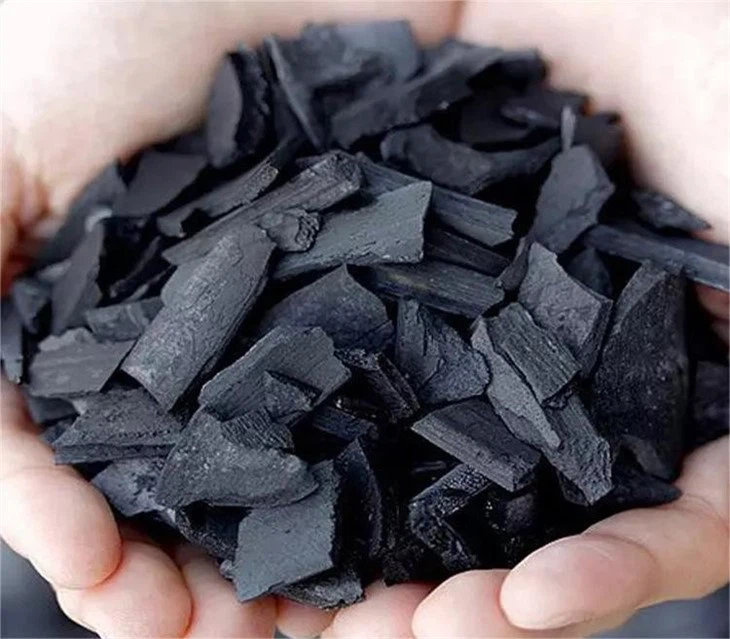


BAMBOO BASED ACTIVATED CARBON
Bamboo charcoal activated carbon is made from bamboo as raw material, and its appearance can be divided into granular, powdered, etc. Bamboo charcoal activated carbon has the characteristics of high mechanical strength, well-developed fine pore structure, fast adsorption speed, high adsorption capacity, easy regeneration, and durability. The specific surface area of bamboo charcoal activated carbon can reach up to 2000 ㎡/g, making it easier to adsorb toxic and harmful gases.

Activated carbon is a functional carbon material with strong adsorption capacity, with a special microcrystalline structure, well-developed pores, large specific surface area, and dual physical and chemical adsorption properties. It can selectively adsorb various unfavorable substances in the liquid/gas phase to achieve decontamination and purification, purification and desulfurization, CO2 removal, decolorization and purification, solvent recovery, catalyst and carrier. The bamboo activated carbon material selection is made from high-quality bamboo as raw material, activated by physical and chemical methods.
Bamboo charcoal activated carbon has a large specific surface area and strong adsorption capacity. The particle shape is full and uniform, which greatly improves the wear resistance of the product. After entering the factory, there is no need for pre-grinding, and it can be used directly after washing with water.

| BAMBOO BASED ACTIVATED CARBON | ||
| Specification | Top quality product | |
| size | 6x12mesh,8x16mesh,0.4-0.8mm,1-2mm,2-4mm,4-8mm | |
|
1000-1300 | |
| Moisture | below 5% | |
| Packing denstity | 0.35-0.45% | |

Characteristics of Bamboo Charcoal Activated Carbon
1. Adsorption of harmful air: Bamboo charcoal activated carbon is pure natural, with many pores and rich minerals. One gram of bamboo charcoal activated carbon has a specific surface area of up to 2000 square meters/g, and has strong adsorption capacity. Microorganisms attached to the molecular surface can completely decompose the adsorbed harmful substances. Generally speaking, the amount of harmful gases in homes is much smaller than the amount of activated carbon used, so bamboo charcoal activated carbon used in homes can be used for a long time after adsorbing harmful substances and often being exposed to the sun.
2. Sterilization and decomposition function: Generally, activated carbon only has adsorption function, and the antibacterial effect of bamboo charcoal activated carbon is also very prominent! Bamboo charcoal activated carbon is pure natural bamboo charcoal before high-temperature activation. Bamboo charcoal activated carbon retains the microcrystals of bamboo charcoal and has a unique effect on the catalytic decomposition of organic pollutants. The decomposition rate of DDT pesticides by charcoal crystals is over 98%. At the same time, bamboo charcoal activated carbon has a strong catalytic decomposition ability for harmful gases such as formaldehyde and toluene.
3. Developed microporous structure and more targeted adsorption: Bamboo charcoal activated carbon is dominated by micropores, with micropores (diameter ≤ 2nm) accounting for up to 90% of the total pore volume. The average pore diameter is about 1.5nm, slightly larger than the diameter of toxic gas molecules, which is more conducive to adsorbing health killers such as formaldehyde, benzene series, TVOC, and bacteria.
4. Large surface area and stronger adsorption: Take 1 gram of bamboo charcoal activated carbon, dissect it, and spread all pore walls into a plane, which can reach up to 2000 square meters (i.e. 2000 square meters per gram of specific surface area). The "lung capacity" is super strong and can adsorb more toxic gases.
5. Negative ion mineral crystals: Bamboo charcoal activated carbon contains negative ion mineral crystals, which can release far-infrared light suitable for human absorption, generate slight heat in the body, promote blood circulation, improve the human circulatory system, relax nerves, and eliminate fatigue! It can also shield electromagnetic waves. This power is only unique to bamboo charcoal activated carbon!


Bamboo activated carbon vsTraditional activated carbon
① Coal based activated carbon: Resources are limited by non renewable fossil fuels, and physical methods are mainly used. The pH is mainly alkaline with small pores, and there are many secondary pores. Medium and large pores are not well developed. Gas phase indicators: iodine value 800-1000mg/g, carbon tetrachloride 40-80%, liquid phase indicators: methylene blue 180-225mg/g, with acceptable strength and high ash content.
② Wooden activated carbon: mainly composed of wood chips, commonly used in the chemical phosphoric acid method. Ph is acidic and has low ash content, and acid washing is added to ensure it is not dangerous. Due to its weak strength, it is mainly made of powdered carbon without crushed carbon, with well-developed mesopores and excellent indicators for molasses or caramel decolorization. Its application fields are mainly in the food and other industries for decolorization, flavor removal, and refining.
③ Coconut shell activated carbon: The raw material mainly relies on imported physical methods, with alkaline pH, hard strength, low ash content, and high price. It is mainly made of crushed carbon and is mainly used in gold extraction and water purification and clearance fields.
Identification of Bamboo Charcoal Activated Carbon
1. By volume, by weight:
Pure bamboo charcoal activated carbon has many pores, is very loose, and has a relatively light feel. Therefore, under the same weight, high-quality bamboo charcoal activated carbon has a much larger volume than general activated carbon.
2. Look at bubbles:
Putting a small handful of bamboo charcoal activated carbon into water will produce a very small bubble line and make a faint sound. The finer the bubble line, the stronger it becomes, and the longer it lasts, the better the adsorption capacity of the activated carbon.
3. See decolorization ability:
Add a drop of red ink to the pure water in the cup and stir evenly. Take half of the sample and leave it. Place activated carbon (with a quantity of more than half of the water) in water and let it stand for 10-20 minutes before comparing it with the water sample. The stronger the decolorization effect, the better the adsorption capacity.
4. Look at particle size:
The smaller the activated carbon particles, the larger the contact area with air, and the larger the specific surface area, resulting in better adsorption performance. Activated carbon with a particle diameter of approximately 0.5 millimeters can achieve optimal performance. It is recommended to choose activated carbon with a particle diameter between 0.42 and 0.85 millimeters.


