


Activated carbon water treatment is an adsorption process in which impurities are trapped on the surface of carbon particles through adsorption.
Activated carbon particles have a porous microstructure with a very large surface area.
Adsorption efficiency depends on parameters such as molecular size, pore size, surface area, particle concentration, temperature, and contact time.
Adsorption Process
Adsorption is the phenomenon of molecules or particles collecting on a solid surface. An "adsorbent" can be any solid material with bonding sites to which the adsorbate can bind.
The most commonly used commercial adsorbent in water treatment is activated carbon.
Applications of Activated Carbon in Water Treatment
Activated carbon filtration is used for:
Removing taste and odor from water.
Reducing health risks.
Preventing damage to reverse osmosis membranes and ion exchange resins.
Tertiary treatment of wastewater.
Pretreatment of industrial water, and more.
Different types of activated carbon can remove different types of contaminants:
Chlorine residuals from disinfection processes-chlorine or chloramines, and some disinfection byproducts (DBPs), such as trihalomethanes (THMs). Organic compounds, including solvents, pesticides, and industrial waste.
Some heavy metals, such as lead and...
However, activated carbon filters cannot eliminate bacteria, viruses, and mineral salts.
What's so special about activated carbon?
Activated carbon is carbon that has been processed to increase its surface area to approximately 1000 m²/g.
Its structure results in a very large number of tiny pores between carbon atoms, resulting in a very large surface area.
A few grams (approximately 5 grams) of activated carbon have a surface area equivalent to that of a football field!
Activated carbon is hydrophobic and has a strong affinity for organic compounds and non-polar pollutants. Adsorption is primarily driven by van der Waals forces.
Activated Carbon Raw Materials
Activated carbon comes in many types, each with its own specific properties. It is made from a variety of high-carbon-content raw materials, such as:
Mineral carbon
Wood
Coconut shells
Bamboo
Activated carbon must have a large number of micropores, distributed appropriately, to adsorb molecules of varying sizes.
In addition, it must contain larger pores to facilitate the entry of molecules into the smallest pores.
Therefore, the production process must be controlled to meet specific pore size distribution requirements.
Activated Carbon Forms
For water treatment, activated carbon comes in two main forms:
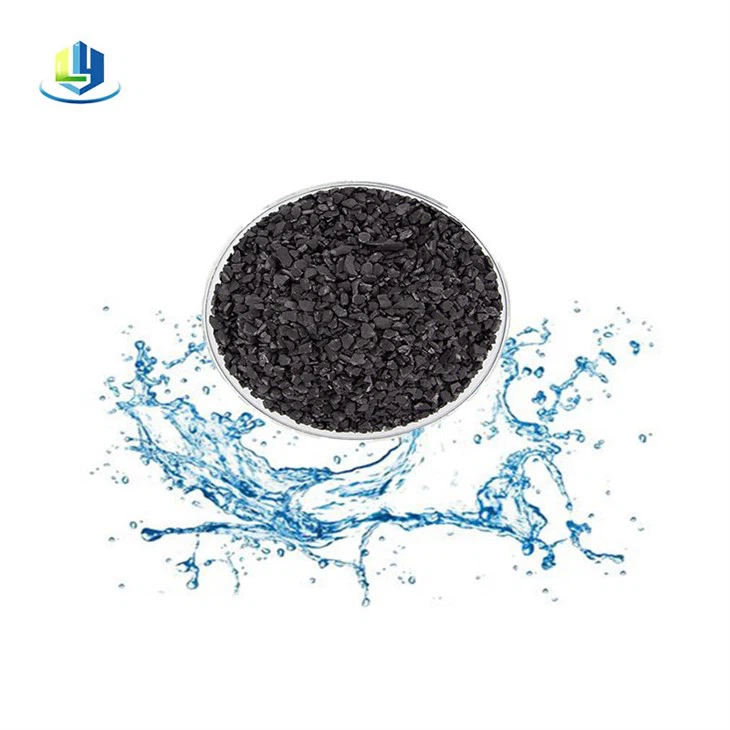
Powdered activated carbon (PAC) – a crushed, ground material with most particles having a diameter of less than 0.18 mm (80 mesh).
Granular activated carbon (GAC) – irregularly shaped, typically with diameters between 0.2 and 1.5 mm.
The water treatment process involves adding PAC to water or passing water through a GAC bed.
PAC is used in water treatment plants to control taste and odor and/or eliminate organic matter.
It is used in dry powder or slurry form.
Dry powder – metered using dry powder feed equipment for dosing dry materials. It is suitable for low and infrequent dosing.
Slurry – metered using a metering pump. This method is used when PAC additions are frequent and high dosages are required.
GAC is primarily used as a post-filtration filter, following conventional filtration processes, or within granular media filters where a portion of the filter bed is replaced by GAC.
In a post-filtration configuration, the GAC filter receives high-quality water because it has already passed through the entire treatment process.