


Swimming pool water treatment is divided into two parts: physical process and chemical process. These two processes are indispensable in the process of swimming pool water treatment.
The physical process is that the swimming pool water is purified by the filtering effect of the circulating water treatment equipment.
The chemical process refers to adding chemicals to disinfect, flocculate, and remove algae while the pool water is circulating, and then make the pool water clean and hygienic through the action of the physical process.
At present, the filtration systems commonly used in the swimming pool water treatment industry are mainly based on quartz sand pressure filtration and diatomite pressure filtration, as well as relatively small wall-mounted integrated filters and gravity filters.
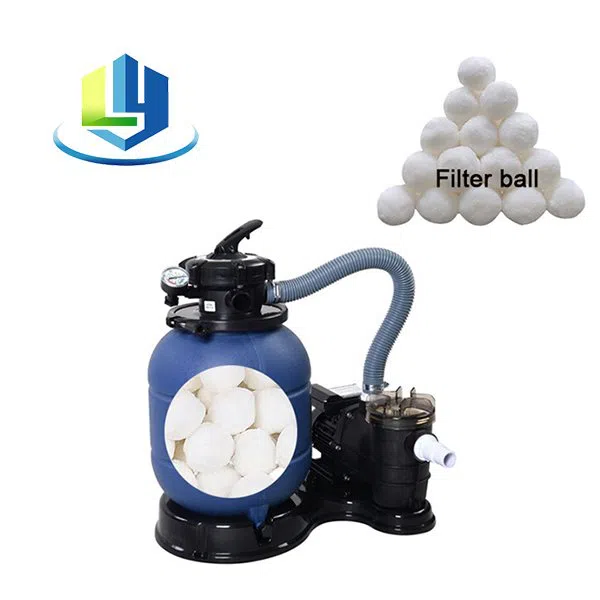
An introduction to the four filtering methods
1. Brief introduction of quartz sand filtration process
Quartz sand filter materials are generally made of high-quality carbon steel lined rubber anti-corrosion stainless steel and reinforced glass fiber materials, which are required to resist the dual corrosion of ozone and chloride ions, and the design pressure is 0.6MPa.
There is an automatic exhaust valve on the top of the device for timely discharge of air sucked in due to careless operation. Holes are provided in the middle or top of the tank for easy access and replacement or filling of filter material.
The quartz sand filter material should be 0.45-0.8mm refined quartz natural sea sand filter material, and the lower part of the cylinder should be equipped with a cobblestone (particle size 2mm-32mm) support layer.
In order to achieve the purpose of deep filtration, the thickness of the effective filter layer should not be less than 700mm, and it must be equipped with a water head of 4-5 meters.
Considering the increase in the fouling amount of the filter material during the filtration process, the pressure in the sand box increases, so the pressure bearing capacity of the cylinder is required to be greater than 0.6MPa.
The tank is equipped with a sight glass, a low pressure waterproof light can be installed if required, and a medium level of dirt in the sand box can be observed.
2 Introduction to Diatomite Filtration Process
Pressure diatomite filters can be divided into plate and frame diatomite filters and candle diatomite filters. The plate and frame type diatomite filter is composed of multiple filter units, each filter unit is composed of a filter plate, a filter frame and a filter cloth, and the filter cloth is sandwiched between the plate frames as an adsorption filter medium
The shape of the candle-type diatomite filter is similar to the shape of the vertical quartz sand filter, and its interior is composed of filter elements similar to the candle shape, so it is called the candle-type diatomite filter.
During filtration, a diatomaceous earth precoat is first formed on the filter candle. When the material passes through the diatomaceous earth filter layer attached to the surface of the filter candle column, it intercepts the suspended solids and colloidal particles to achieve the purpose of filtration.
Diatomite filter material is a siliceous biological sedimentary rock with opal as the main mineral component, which is mainly formed by the deposition of the remains of single-celled aquatic plant diatoms. It has the characteristics of porosity, large surface area and chemical stability, and is a natural filter aid.
In addition, diatomaceous earth also has unique ion selectivity and killing properties of anti-chlorine pathogens. With the passage of time, the diatomite filter will filter out more and more impurities on the precoat and will block the filter channel, so a certain amount of diatomite should be added, so that the diatomite will be added to the filtrate along with it.
The suspended solids can be retained and adsorbed by the filter screen at the same time, forming a new filter layer, preventing all the microfiltration pores of the new filter layer from being blocked, maintaining its filtration performance, thereby prolonging the filtration cycle and increasing the total amount of filtration.
3. Introduction to wall-mounted integrated filtration process
Wall-mounted integrated filters generally use high-quality paper core filter elements or polyester fiber elements as filter media, with built-in circulating water pumps, automatic dosing devices, underwater lights and other equipment.
The circulation method is a suction circulation, which is inhaled from the water suction port of the equipment body, and discharged from the water supply port of the equipment body after filtering and purification. Its service scope is only limited to the area around the equipment, and there will be problems of dead ends and eddy currents during use.
It is a non-mainstream filtration process and has a low market utilization rate. It is only suitable for swimming pools with no room, small water volume, and few swimming people, such as: High-end villa outdoor swimming pool, private club swimming pool, etc.
4. Introduction to the process of gravity filter
The best application of gravity filter is the improvement of water quality and environment of natural or artificial landscape water bodies.
Its aeration and oxygen melting activate water bodies, and sand bed filtration is conducive to removing organic pollutants in such water bodies and reducing turbidity. It belongs to environmental microorganisms.
Water treatment process in the field of science. The water treatment of swimming leisure and recreational water belongs to the medical disinfection process of disinfection and sterilization of medical microorganisms, and there are essential differences between the two.
Gravity filtration technology was first used in water treatment of natural or artificial landscape water bodies.
In the past decade, the use cases of gravity filtration systems have also appeared in technologies and equipment for recreational water treatment such as swimming pools and water parks, but the overall market share less rate.
The working process of the gravity filter is to send the raw water into the water distribution tank for uniform distribution, and then through the air isolation device, the raw water is aerated and oxygenated. It comes out, and then inhales the oxygen in the air.
This system is also called (breathing system), and after completion, it enters the fine filter, (the fine filter is composed of multi-layer anti-composite filter materials) and filters from top to bottom, as shown in the following schematic diagram of the filtration process.
As the filter layer keeps intercepting the suspended solids in the water body, the resistance of the filter layer gradually increases, so that the water level of the siphon pipe rises.
When the water level rises to the set position, it enters the air suction device in the siphon auxiliary pipe, and the air in the siphon pipe is taken away due to the hydraulic effect. , forming a negative pressure. When the negative pressure reaches the design value, the siphon phenomenon occurs.
At this time, the water in the water tank forms a reverse flow, and the filter layer is continuously flushed from the bottom to the top from the bottom of the filter layer, and the filter layer is "regenerated".
Due to the continuous backwashing of the filter layer, the backwashing sewage is discharged to the sewer pipe. When the water level in the water tank drops to the specified value, the siphon effect is destroyed, the backwashing is over, and the filter starts to work again.