


Modified fiber balls are fiber balls made of modified fiber filaments.
Modified fiber yarn is spun from a copolymer of the second monomer and the third monomer with a content of 35% to 85%. It is processed through preheating, steam drawing, water washing, drying, heat setting, curling, splitting, knotting, cutting, packaging and other processes. It is a high molecular polymer with properties very similar to wool. It has good elasticity and can maintain a rebound rate of 65% when stretched by 20%. It is fluffy, curly, soft and is known as synthetic wool. Its strength is 1 to 2.5 times that of wool, and it has excellent light resistance. After one year of exposure to sunlight, its intensity decreases by only 20%. The fiber balls made from it have good elasticity, large specific surface area, high porosity and adjustable filtration speed. It is the first choice for high-precision water quality filtration. It is suitable for fine filtration of oily wastewater in oil fields and fine filtration of other industrial wastewater. Here are some differences between the two:
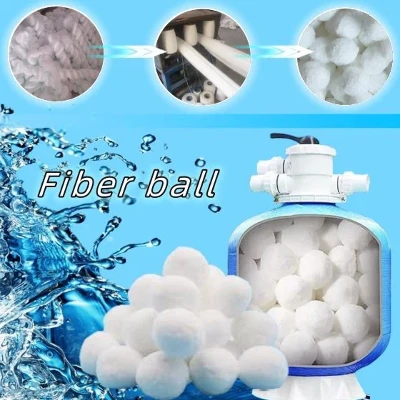
Fiber balls:
Fiber balls are usually small spherical objects made of various fiber materials. They are often used in filtration systems, especially swimming pool and pond filters.
These balls are designed to capture and filter particles and impurities in water. They can be made from materials such as polyester, polypropylene, or other synthetic fibers.
Fiber balls are used as an alternative to sand filters or cartridge filters in pool or pond filtration systems because they capture smaller particles more efficiently and require less maintenance.
Modified fiber balls:
Modified fiber balls can refer to fiber balls that have been modified to improve their properties or customized for a specific application. You can modify it in several ways:
A. Surface treatment: The surface of the fiber ball can be modified through chemical treatment to enhance its filtration ability. For example, hydrophilic (water-absorbing) surface treatments can improve their wetting properties and particle capture efficiency.
B. Composition: The materials used to make fiber balls can be modified. Researchers may try different fiber types or blends to optimize filtration performance. They can also incorporate additives or coatings to enhance specific properties.
C. Size and Shape: Changing the size or shape of the fiber balls may be another approach. Changing the size may affect how efficiently they capture particles of different sizes, while changing the shape may affect how they pack up in the filter.
D. Application-Specific Modifications: Fiber balls can be customized for specific applications. For example, in wastewater treatment, modifications may focus on adsorbing specific pollutants, whereas in air filtration, modifications may focus on capturing airborne particles.
E. Durability: Changing the structural integrity of the fiber ball can make it more durable and long-lasting, thus reducing the frequency of replacement.
Fiber balls are made by tying fibers together. Compared with traditional granular filter media, it has the advantages of good elasticity, non-floating surface, large pore size, small water head loss, and acid and alkali resistance. It has high efficiency, fast filtration speed, strong interception ability and is renewable. Suitable for filtration of various water qualities. If you need this product, you can contact us at any time.