


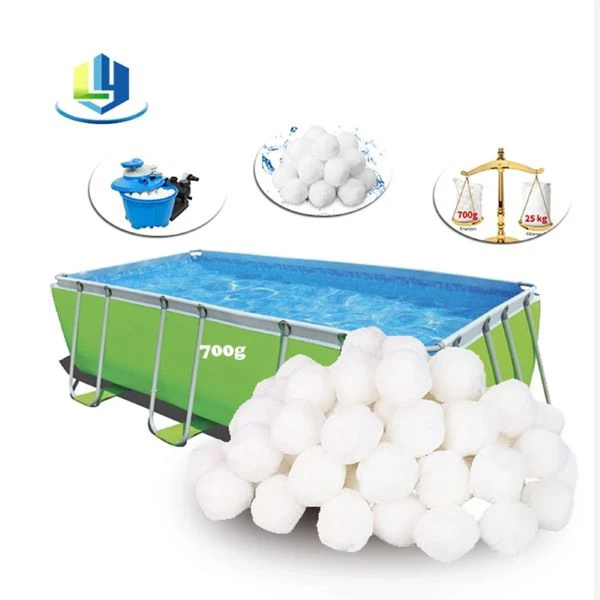
Fiber balls are small hair balls formed by ligating fiber filaments. Fiber filaments are made of chemical fibers. The main characteristics of filaments are lipophilic and hydrophobic. Due to their high density, the fiber balls can trap oil in the water during filtration, just like normal particulate filter materials. However, due to the low density of ordinary particulate filter materials, it is unable to intercept oil contamination below the density. Fiber balls are much denser than oil pollution molecules and can effectively intercept oil pollution in water.
At first, the fiber ball was born only to filter the oil in the water, without considering its service life, so the service life of the fiber ball is generally less than 2 years. Since the fibrils are lipophilic and hydrophobic, when the fiber ball filter is backwashing the fiber ball, the oil attached to the surface of the fiber ball is not easy to clean, which shortens the service life of the fiber ball. Later, after the response of various customers, we asked the fiber silk manufacturers to jointly research and improve the fiber silk, so that the characteristics of the fiber silk changed from lipophilic and hydrophobic to hydrophilic and oleophobic, which greatly improved the service life of the fiber ball. Clean the oil on the surface of the fiber balls. Improve the service life of fiber balls.
Due to the high density of fiber balls and small intermediate pores, the fiber ball filter adopts the filter press method, and the oil removal rate reaches 98.9%, which meets the drainage standard. Introducing these, everyone knows why fiber balls can filter oil in water.