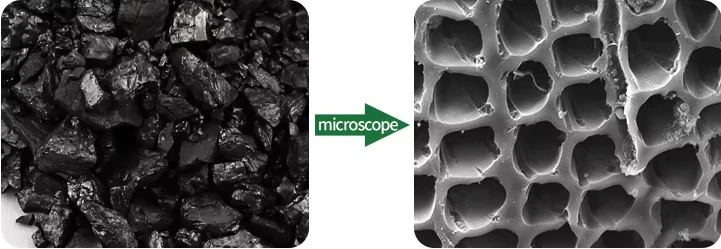
Activated carbon is a highly effective material for removing chemical contaminants from water and air. One of its main strengths is its high adsorptive capability, which is a result of its large surface area and chemical affinity for organic molecules. Because activated carbon has a nonpolar nature, it attracts other nonpolar molecules like a magnet. This means that it can adsorb a higher quantity of adsorbates at a faster rate than other materials. Additionally, activated carbon is highly versatile and can be customized to target specific contaminants, making it a valuable tool for a variety of applications in water and air purification.
Activated carbon is known for its high adsorptive capability. In adsorption, an adsorbate is held onto the surface of a material. Activated carbon can effectively adsorb a wide range of molecules and ions due to its unique porous structure and large surface area. It can remove impurities from water and air, and is commonly used in air and water purification systems. The adsorption process can occur via physical or chemical processes. Physical adsorption occurs when attractive forces between the adsorbate and material surface hold the adsorbate in place. Chemical adsorption occurs when chemical reactions between the adsorbate and surface create chemical bonds, resulting in stronger adsorption.